

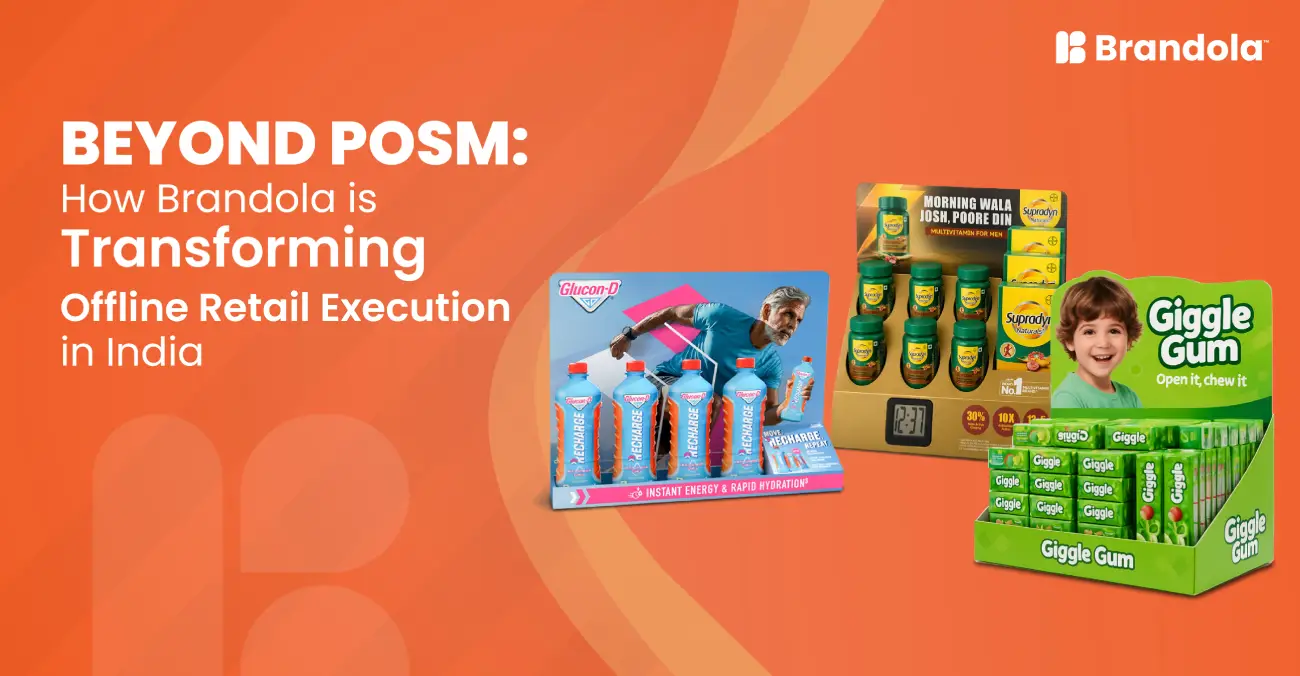

Beyond POSM: How Brandola is Transforming Offline Retail Execution in India
Walk into any kirana store, supermarket, or modern trade outlet in India, and you’ll still see the familiar signs of a brand’s presence a poster here, a shelf-talker there, a standee by the counter. For decades, Point-of-Sale Materials (POSM) have been the default language brands use to speak to shoppers at the last mile. But in a market as vast, fragmented, and fast-moving as India’s offline retail landscape, with well over 12 million kirana stores alone, alongside a growing base of modern trade outlets POSM was never designed to answer the harder questions: Did it actually get placed? Is it still there next week? Is it driving any sales at all?
This is the gap Brandola is built to close. Brandola is redefining what “retail execution” means for brands operating in India, moving the conversation beyond printed materials and into real-time visibility, accountability, and measurable in-store impact.
Beyond POSM: Making Retail Execution Measurable
POSM remains one of the most effective ways to build visibility and influence shopper decisions at the point of purchase. However, as retail networks become larger and more complex, brands increasingly need greater visibility into how these materials are executed in-store. While distributing POSM is an important first step, understanding where it has been placed, whether it is maintained, and how it contributes to retail performance is equally important. This is where technology-enabled retail execution adds significant value.
Limited visibility into execution:
Once POSM materials are dispatched, it can be difficult for brands to verify whether they have been installed correctly, displayed in the intended location, or maintained throughout the campaign. Without real-time visibility, ensuring consistent execution across thousands of outlets becomes a challenge.
Limited insight into retail performance:
While POSM helps improve brand visibility, it does not by itself indicate whether products are available on shelves, priced correctly, or receiving adequate shelf space. Understanding these factors alongside POSM execution provides a more complete picture of in-store performance.
Opportunities to improve marketing ROI:
Producing and distributing POSM across a large retail network represents a significant investment. Without a structured mechanism to verify execution and measure outcomes, brands may find it difficult to evaluate the true return on their trade marketing spend or identify opportunities for optimisation.
Fragmented field communication:
Sales teams, distributors, and brand managers often work with information collected at different times and through different processes. A unified, real-time execution platform helps ensure everyone works from the same up-to-date information, enabling faster and better-informed decisions.
Manual audits have limited coverage:
Store visits and market audits remain valuable, but they can only cover a small portion of the retail universe at any given time. Digital execution tracking complements these audits by providing continuous visibility across a much larger network of outlets.
Ultimately, POSM is most effective when it is supported by measurable retail execution. Rather than simply knowing what was distributed, brands gain confidence by understanding what was actually implemented, how consistently it was maintained, and how it contributed to in-store performance. This shift transforms retail execution from a one-time activity into a continuous, data-driven process that delivers greater accountability and stronger business outcomes.
Also, read our blog
Retail Branding Explained: Market Trends, Case Studies & Growth Strategies
Brandola’s Approach: Execution as a System, Not a Shipment
Brandola treats retail execution as an end-to-end, data-driven process rather than a one-time distribution exercise. Instead of measuring success by units dispatched, Brandola focuses on what happens at the shelf visibility, availability, and verified compliance and connects that data back to the people who can act on it.
Real-time, photo-verified store visits:
Field teams capture on-ground evidence directly from stores, giving brand and sales leaders a live, geo-tagged view of execution quality instead of relying on delayed or manual reporting. Every visit becomes a data point, not just a checkbox on a report.
Shelf and stock intelligence:
Rather than treating “presence” as binary, Brandola’s platform helps teams track share of shelf, stock-outs, and planogram compliance, surfacing issues before they become lost sales. If a competitor has quietly taken over shelf space in a cluster of outlets, that pattern becomes visible instead of anecdotal.
Actionable dashboards for decision-makers:
Data collected from thousands of outlets is rolled up into dashboards that let regional and national teams spot patterns which territories are underperforming, which SKUs are losing shelf space, where field effort needs to be redirected. This turns execution data from a static report into a living decision-making tool.
Closing the loop with field teams:
Instead of a one-way flow of instructions from HQ to the field, Brandola creates a feedback mechanism where on-ground reality informs strategy, and strategy is communicated back to the field with clarity. Field reps aren’t just executing tasks; they’re contributing to a system that gets smarter with every visit.
Task and beat planning built around evidence:
Rather than field visits being scheduled purely on habit or geography, Brandola enables planning informed by where issues are actually occurring prioritizing outlets that need attention rather than treating every store on a beat as equal.
Why This Matters for Indian Retail Specifically
India’s offline retail environment isn’t a smaller version of organized retail markets elsewhere it’s structurally different. Outlets are numerous, geographically dispersed, and highly varied in size, digital readiness, and buying behavior. A hypermarket in a metro and a single-counter kirana store in a tier-3 town operate under completely different constraints, yet both are part of the same distribution network a brand has to manage. A strategy built around static materials and manual audits simply cannot scale to match this complexity.
Brandola’s model is built around this reality rather than against it. By digitizing execution and making it measurable at the individual outlet level, brands gain the ability to:
- Direct marketing and trade spend toward outlets and regions that actually move the needle, rather than spreading budgets thin across every outlet uniformly.
- Reduce wastage on POSM and promotional materials that go unused, mis-delivered, or unverified freeing up budget to be redeployed where it has proven impact.
- Hold distributors and field teams accountable with objective, timestamped, geo-tagged data instead of relying on self-reported completion.
- React faster to competitive activity, stock-outs, or compliance gaps, closing the loop between a problem occurring in the field and a decision being made at headquarters.
- Benchmark performance across regions and channels, identifying not just where things are going wrong, but where things are going right and can be replicated elsewhere.
This last point matters more than it might seem. Most execution systems are built to flag problems. Fewer are built to help a brand understand what a high-performing territory is doing differently information that, in a market as regionally diverse as India, can be the difference between a strategy that works nationally and one that only works in pockets.
From Materials to Metrics
The shift Brandola represents is fundamentally a shift in mindset from “we sent the materials” to “we know what happened at the shelf.” That distinction matters enormously for brands trying to justify trade marketing budgets, optimize field force productivity, or simply understand why sales in one district look nothing like sales in another.
For category and trade marketing leaders, this shift also changes the nature of internal conversations. Instead of debating whether an execution issue exists, teams can look at verified data and debate what to do about it. Instead of allocating next quarter’s POSM budget based on last year’s pattern, teams can allocate it based on where compliance and shelf share actually moved the needle this quarter. Execution stops being a cost center that’s hard to justify, and starts becoming a lever that can be optimized like any other part of the marketing mix.
POSM isn’t going away visual merchandising still plays a real role in shopper decision-making, and a well-placed display can absolutely influence a purchase at the shelf. But it can no longer be the entire strategy. The brands winning offline retail in India today are the ones treating execution as a measurable, manageable system, not a one-time distribution task that ends the moment materials leave the warehouse.
That’s the shift Brandola is enabling helping brands move beyond POSM and into a world where every rupee spent on retail execution can be tracked, verified, and optimized, and where field teams, regional managers, and brand leaders all work off the same real-time picture of what’s actually happening at the shelf.
Ready to See Execution Differently?
If your brand is still measuring retail execution by materials shipped rather than results delivered, it may be time for a different approach. Get in touch with Brandola to see how real-time, data-driven execution can transform your offline retail strategy one verified store visit at a time.